

Stuck right nowLockouts
Does a locksmith break your lock to get you in?
A good locksmith gets you in and leaves the lock working. Here is how that's done, the few cases where drilling is the right call, and the questions that tell you who you're dealing with.
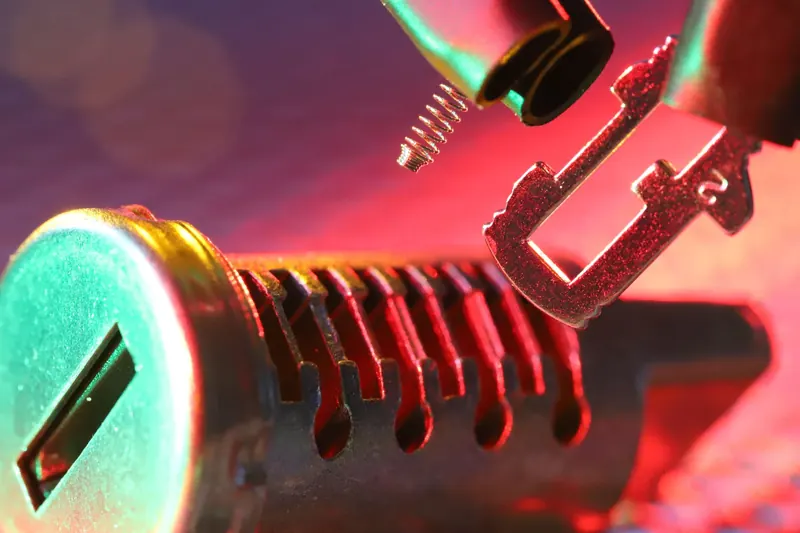
It helps to know this before you call. Standing outside late at night in sleet, most people will agree to whatever gets them back indoors.
What does a locksmith actually do at your door?
Most residential deadbolts and knob locks are pin tumbler locks. Inside the cylinder is a row of small pins on springs. The right key lifts each pin to exactly the right height, the cylinder turns, and the bolt moves. A locksmith reproduces that without the key.
- Picking. One tool applies a light turning force to the cylinder while a pick lifts and sets the pins one at a time. On a standard house lock, an experienced hand usually opens it without leaving a mark.
- Bypass. Some locks don't need the pins touched at all. The latch can sometimes be worked directly, or a gap the door already has gives access to the mechanism. It depends on the lock and how the door is hung.
- Specialist tools. A locksmith's kit includes tools for particular lock types and situations, all aimed at the same result: door open, lock unharmed.
After that, the lock turns and locks as it always did, your key still fits, and nothing needs replacing.
This one is a call, not a fix.
Most house locks open by picking or bypass, and afterwards the lock and your key work exactly as before.
Emergency locksmithDo older Halifax locks open the same way?
Mostly, yes. Many older wooden homes on the Halifax peninsula and in downtown Dartmouth still have mortise locks set into the edge of the door, and storm doors with a latch of their own. Mortise cylinders are pin tumbler locks too and can usually be picked. The bigger risk with old hardware is wear: a tired mechanism is more likely to have failed inside, which leads to the next section.
When does a lock really need drilling?
There are honest reasons to drill, and a good locksmith tells you which one applies.
- Something has broken inside. A snapped cam or tailpiece, or a cylinder that has come apart, can't be picked open because turning it no longer moves the bolt.
- Corrosion or ice has seized it. Salt air near the harbour and the coast, road salt carried on keys, and water that gets in and freezes during freeze-thaw swings can leave a cylinder too stiff to pick. Thawing and lubricating sometimes frees it; sometimes it doesn't.
- It's a high-security cylinder. Some cylinders are designed to resist picking and bypass. Opening one without the key may mean drilling, and that resistance is what the lock was bought for.
- A key has snapped deep inside. Normally the broken piece can be extracted. Occasionally the cylinder is damaged enough that replacing it is the sensible choice.
Whatever the reason, the locksmith should stop, explain it, tell you what drilling means (a new cylinder or lock), and wait for your go-ahead.
This one is a call, not a fix.
A broken, seized or broken-key lock can need drilling. You should hear why, and be asked, before it starts.
Emergency locksmithWhy should drilling first make you wary?
Because drilling turns a simple opening into a lock replacement, and the bill grows to match. It's also a pattern that turns up in locksmith complaints across Canada.
CBC News in Calgary reported on a homeowner who was told her locks were too complicated to pick and needed drilling. Another locksmith later told her neither lock had needed it (CBC News). Locksmiths interviewed for the same story said fake operators commonly claim a lock must be drilled when it doesn't have to be.
What it looks like on your doorstep: someone glances at a standard deadbolt, calls it a special lock, and gets the drill out without attempting anything else. You are entitled to say no and ask them to go. Our page on how to spot a fake locksmith lists the other warning signs.
If nothing else has been tried, you can say no and ask them to leave.
Questions to ask before anyone starts
Asking questions is reasonable, even when you're cold and tired, and a genuine locksmith expects them.
- "How are you going to open it?" The answer you want is picking or bypass, not the drill.
- "Will you check with me before drilling?" Yes is the only acceptable reply.
- "How is the price worked out?" Settle it before work begins, and ask to be told before anything changes.
- "Can I see some ID?" Expect to be asked for yours as well. A careful locksmith confirms who you are before opening a door, and what a real locksmith asks for explains what to have ready.
Our own approach: we pick or bypass before we drill, and if a lock does need drilling we explain why before we touch it. If you need help now, our emergency locksmith page has the call and text buttons.
Read this before you try anything else. Not sure? Call and we'll talk you through it.
What about keypad and smart locks?
The answer barely changes. Many keypad and smart deadbolts hide an ordinary key cylinder under a cover, and it opens like any other. If the real problem is a dead battery rather than a lost key, use the lock's own backup first. Our guide to a keypad door lock battery dead covers the 9-volt contacts and backup keys by brand.
Try the lock's own backup first, such as the 9-volt contacts or a key cylinder hidden under a cover.
Once you're back inside
If your keys are lost rather than sitting on the kitchen counter, think about where they might be. Keys on a ring with your address, or in a stolen bag with your licence, can still open your door. A rekey changes the inside of the lock so the old keys stop working while the hardware stays put. Our post on should I change locks after losing keys walks through that choice.
And if the lock was already stiff, gritty or loose before you got locked out, say so while the locksmith is there. A lock on its way out tends to cause the next lockout, and in this climate it usually picks the first hard frost to do it.
If the missing keys could lead someone to your address, a rekey makes them useless.
The short version
- Most house locks open with no damage at all.
- Drilling is for broken, seized or high-security locks, and only after you've agreed.
- A locksmith who drills first, without trying anything else, is a red flag.
- Ask how they'll open it and how the price works, and expect to show ID.
Questions people ask
- Will a locksmith have to drill my lock?
- For an ordinary house lockout, rarely. Picking or a bypass method comes first. Drilling is for a lock that has broken internally, a cylinder that is corroded or seized, or certain high-security cylinders designed to resist picking.
- Can opening the lock damage my door?
- Picking and bypass work on the lock, not the door, so both carry on as before. Even when a cylinder has to be drilled, it's the cylinder that gets replaced; the door itself should come through fine.
- What should happen before a lock is drilled?
- The locksmith should have tried non-destructive methods, then stop, explain why drilling is needed and what replacing the cylinder involves, and wait for you to agree before starting.
Still stuck? Call, and a person answers.
Open 24 hours, 7 days. Tell us which one it sounds like, or text a photo first.
Emergency locksmith · You approve the price before we start.
Keep reading
All guides Right now
Keypad or smart lock battery dead? How to get back inside
A dead keypad deadbolt nearly always has a way back in: a key cylinder, two 9-volt contacts or a USB port. Here's how to find yours before you need it on a wet, windy doorstep.
 Right now
Proof of ownership: what a locksmith should ask you for
Before a door is opened, a good locksmith checks you belong there. What to show for a home, a car or a business, and what to do when your ID is on the wrong side of the door.
 Plan ahead
Swapping keys for fobs: access control for a small business
Seasonal staff, part-timers and a back door nobody can account for. Here is how fob and card access works for a small business, and what coastal weather asks of the hardware.