

The best garage door for Halifax weather: salt air, wind and freeze-thaw
Salt air, coastal wind and a winter that freezes and thaws all season ask different things of a garage door. Here is what to look for, part by part.
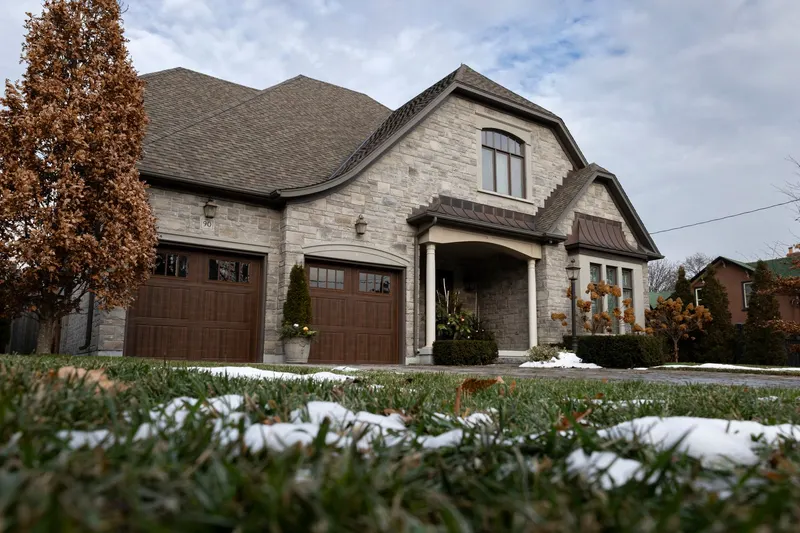
Below is what each part has to survive in Halifax Regional Municipality, and what to ask before you buy.
What does the coast actually do to a garage door?
Four things, and a good door answers all of them:
- Salt. Spray off the harbour and the open coast settles on everything, and road salt splashes up from the driveway all winter. On bare or chipped steel it starts rust; on hinges, rollers and spring wire it eats away quietly where you can't see it.
- Wind. A garage door is the largest opening in most houses. In a nor'easter or a fall storm, a wide door on an exposed lot takes a real push, inward and outward.
- Freeze-thaw. Wet snow melts, refreezes overnight, melts again. Water gets into seams, under seals and into any crack in the finish, and ice levers it open a little more each time.
- Damp. Fog and mild wet spells mean moisture sits on cold metal inside the garage for days. That's where hardware rusts from the inside out.
A door in Eastern Passage or Porters Lake with nothing between it and the water feels all four harder than one tucked into a sheltered street in Clayton Park, but every door in the region deals with salt and freeze-thaw.
Which door materials hold up best to salt air?
| Material | How it handles salt and damp | Worth knowing |
|---|---|---|
| Insulated steel | Good, while the factory finish is intact | Touch up chips and scratches before winter so salt can't reach bare steel |
| Composite or fibreglass skin | Won't rust or rot | Ask what the frame and hardware underneath are made of |
| Aluminum and glass | Doesn't rust like steel, still benefits from a good finish | Large glass areas let more heat out; better for a detached garage |
| Wood | Needs the most care | Swells in damp, and freeze-thaw opens up any gap in the paint |
Steel remains the common pick because it takes insulation well and a good baked-on finish keeps salt off the metal. The weak point is damage: a dent from a bike or a scrape from a shovel that goes through to bare steel. Look for a heavier-gauge skin if the door takes knocks.
Composite and fibreglass give you the wood look without the rot, and suit houses right on the water. Wood is beautiful on an older home on the peninsula, but in salt and fog it needs refinishing on a schedule, and a neglected wood door sticks and splits.
Call or text and a person answers, 24 hours, 7 days. You approve the price before we start.
Does a coastal door need a wind rating?
Ask for one. The door industry's technical guidance notes that vehicle doors sit in a building's largest openings and can face high wind, and that the door maker should be able to give the positive and negative wind pressures, in pounds per square foot, that the chosen door is rated for (DASMA TDS-292).
What that means for you:
- Your building authority sets the requirement, if there is one, for a new build or a major renovation.
- Wide doors flex more. A double door often carries reinforcing struts across the sections; ask whether the model you like has them, or can.
- The framing matters too. A strong door on a weak jamb is only as strong as the jamb, so the opening gets checked as part of the install.
- Insulated sections help. Foam-filled panels are stiffer than single-skin steel.
How much insulation does damp cold call for?
Halifax winters are less about extreme cold than about long, raw, wet stretches around freezing. Insulation earns its place by keeping the inside face of the door warmer, so less moisture condenses on the door, the hardware and whatever you store nearby.
When you compare insulated doors, know what the numbers mean. The industry's technical sheet on thermal performance describes two different measures (DASMA TDS-163):
- R-value is calculated on a single door section and leaves out the joints and attachments. Higher is better, but it only describes the middle of a panel.
- U-factor is tested on the whole door assembly. Lower is better, and it's the more honest comparison where a maker publishes it.
The sheet also points out that the two numbers aren't simple opposites of each other. So compare R-values only between doors of similar construction, and pay as much attention to the thermal break, the strip that stops cold conducting straight from the outer steel skin to the inner one.
Which seals and hardware matter most by the sea?
This is where cheap and good doors really part ways on the coast:
- Bottom seal. It sits in slush and meltwater all winter. A seal that stays flexible in the cold is less likely to freeze to the slab and tear. A retainer that won't rust holds it in place longer.
- Perimeter and section seals. Wind-driven rain and wet snow come in sideways. Seals along the sides, the top and between sections keep water off the inside.
- Hinges, brackets and fasteners. Galvanized or otherwise corrosion-resistant hardware outlasts plain steel in salt air. Ask what finish the hardware has, not just the panels.
- Rollers. Nylon rollers with sealed bearings don't rust on the tread and run quieter than bare steel ones.
- Springs. Coated or galvanized springs are made to resist surface rust. Our guide to how long garage door springs last covers why salt and damp matter so much to them.
What should the springs and opener be matched to?
An insulated door is heavier than a hollow one of the same size, and the springs carry that weight, not the opener. Springs are chosen for the door's exact weight and height, so a new door always gets springs sized for it.
For the opener:
- Battery backup is worth having where storms knock the power out. Without it, you're using the manual release; read garage door manual release before you ever need it.
- Belt drives are quieter under a bedroom; chain drives are simple and tough; wall-mounted units free up the ceiling.
- If your current opener is already acting up, see garage door opener not working before deciding whether to keep it.
Repair the old door or replace it?
Most problems are repairs: a spring, a cable, rollers, an opener. Replacing the door makes sense when:
- rust has come through the panels, or the bottom section is rotted or swollen,
- sections are bent and no longer track straight,
- the door is single-skin and the garage is attached, heated or has a room above,
- the door flexes badly in the wind or rattles in its tracks during storms,
- parts for it are no longer made.
Whatever you choose, a fall check keeps it running. Our winterize your garage door guide walks through seals, springs and the opener before the first freeze.
How do we help you choose?
We start with your site and how you use the garage. We'll look at the opening, headroom and side room, how exposed the door is to wind and spray, whether the garage is heated, and what's above it, and then talk through door options that suit it. See new garage door installation; every install includes springs matched to the new door and an opener set up to suit it.
Questions people ask
- What is the best garage door material near the ocean?
- Insulated steel with a good factory finish is the usual choice, because the finish keeps salt off the metal and the foam stiffens the panels against wind. Composite and fibreglass skins don't rust or rot, which suits very exposed sites. Wood needs the most upkeep in salt air and damp.
- Do I need a wind-rated garage door in Halifax?
- Your local building authority decides what is required for a given building. Even where nothing is specified, it is worth asking the maker what wind pressure the door is rated for, especially for a wide double door on an exposed lot facing the water.
- Is an insulated garage door worth it in Nova Scotia?
- For an attached or heated garage, or one with a room above, yes. Insulated sections are stiffer in the wind, quieter, and the inside face stays warmer, so less damp settles on the door and its hardware through a cold, wet winter.
Ready to sort it? Call or text.
Open 24 hours, 7 days. Text a photo first if that is easier.
New garage door installation · You approve the price before we start.
Keep reading
All guides Right now
Broken garage door spring? How to spot it and what to leave alone
A snapped spring turns a garage door into a dead weight. Here is how to recognise it in a minute, why coastal garages see it often, and how to keep everyone safe until it's fixed.
 Right now
Power out in a storm? Using the garage door manual release safely
When a nor'easter takes the power, the red cord on the opener is how the car gets out. Pulled at the wrong moment it can drop a heavy door. Here is the safe way.
 Right now
Garage door opener stopped working? A quick checklist before you call
Storm outages, a lock button pressed by accident, a damp keypad: most openers that stop working have a simple cause. Here is the order to check them in.