

How long do garage door springs last near the coast?
Spring life is counted in cycles, and in a salty, damp garage those cycles get harder on the steel. Here is how to estimate yours and stretch them.
What does a spring's cycle rating actually mean?
Every time the door goes up and down, the spring winds and unwinds and the steel flexes. Flex steel enough times and it fatigues and cracks. The cycle rating is how many of those flexes the spring is designed to take.
Garaga, a Canadian door maker, says a torsion spring should last around 10,000 cycles (Garaga), and Amarr refers to standard residential springs as 10,000-cycle springs (Amarr).
Treat the rating as a design target. The door industry's technical sheet on spring life explains that handling, installation and the way a door is used all affect how long a spring really lasts, and that spring life won't necessarily match the life of the door (DASMA TDS-190).
How many years will my springs get?
Count your household's cycles on an ordinary day: the drive to work, school drop-off and pick-up, bikes in and out, a run to the green bin. Multiply by 365, then divide 10,000 by the result.
On a standard 10,000-cycle spring, used every day of the year:
| Opens and closes a day | A year | Roughly how long the spring lasts |
|---|---|---|
| 2 | 730 | about 13 years |
| 3 | 1,095 | about 9 years |
| 5 | 1,825 | about 5 and a half years |
| 7 | 2,555 | about 4 years |
| 10 | 3,650 | under 3 years |
Those figures are for a spring in good conditions. If the garage is the family's front door, you're near the bottom of the table. If you bought the house and have no record of the springs, assume they're older than you'd hope.
Read this before you try anything else. Not sure? Call and we'll talk you through it.
Does salt air shorten spring life?
Yes, and it's the main reason coastal springs often fall short of what the arithmetic suggests.
The industry's spring-life sheet says springs should be kept dry, because rust reduces the effective area of the spring wire and its overall strength, and corrosion pits give fatigue cracks a place to start and grow faster (DASMA TDS-190). It also advises that doors in places with frequent precipitation, or near a saline coast, be kept closed where possible.
Halifax ticks both boxes. Salt spray reaches garages near the harbour and along the shore, road salt rides in on every car through the winter, and fog and mild wet spells keep unheated garages damp for days at a time. Rust along the coils is worth taking seriously even when the door still runs well.
If your garage is close to the water or stays damp, ask about coated or galvanized springs, which are made to resist surface rust.
Read this before you try anything else. Not sure? Call and we'll talk you through it.
When are longer-life springs worth it?
Springs come in higher cycle ratings for doors that work harder. For its commercial doors, Garaga lists torsion springs rated at 25,000, 50,000, 75,000 and 100,000 cycles, and works out the need by multiplying average daily cycles by 250 working days and by ten years (Garaga).
At home, a higher-cycle spring is worth discussing when:
- the garage is how everyone gets in and out,
- several drivers come and go through the day,
- the garage doubles as a workshop or home business,
- this is the second set of springs and you'd rather not do it a third time soon.
Whatever the rating, the spring is sized to the door's weight and height first. Cycle life is chosen on top of that, never instead of it.
How do I know mine are wearing out?
You can catch a tired spring before it breaks:
- The balance test. With the door closed, pull the release, lift the door to about halfway by hand and let go carefully. A balanced door stays where it is. One that drifts down has springs losing strength. The full routine is in how to winterize a garage door.
- It's heavier than it used to be when you lift it by hand.
- The opener labours, slows down or stops short of fully open.
- Rust on the coils, especially flaky rust or pitting rather than a light surface tint.
- Coils pulling apart, on a torsion spring, or extension spring coils that stay stretched with the door closed.
- Squeaks or grinding from the springs that come back soon after lubricating.
An open split in the coil means the spring has already broken. Stop using the door and see garage door spring broken.
A door that drifts down has springs losing strength. An open split in the coil means it has already broken, so stop using the door.
Why replace both springs together?
A two-spring door usually has a matched pair fitted the same day. They've done identical cycles and lived in the same salt and damp, so when one breaks, the other is worn just as far, and it had to carry the whole door for at least a moment. Replacing both keeps the door evenly balanced and saves you a second call shortly after.
The cables, drums and bottom brackets get checked at the same visit. They take a jolt when a spring breaks, and on the coast they rust too.
Read this before you try anything else. Not sure? Call and we'll talk you through it.
How do I get the most out of my springs?
Nothing adds cycles to a spring, but you can stop losing them early:
- Lubricate the springs as the door maker's instructions direct. The industry guidance says regular lubrication helps maximise spring cycle life, and a light coat also keeps moisture off the wire.
- Keep the garage as dry as you can. Fix leaks, sweep out meltwater, and leave the door closed in wet or stormy weather.
- Wipe off salt brought in on the car before it dries on the hardware.
- Keep the door balanced. An unbalanced door makes the springs and the opener work harder.
- Don't add weight to the door, such as a do-it-yourself insulation kit or heavy decorations, without having the springs rebalanced.
Planning a new insulated door? It weighs more, so the springs must match it. That's part of choosing the best garage door for a coastal climate.
If your door fails the balance test, or your cycle count makes you uneasy, book a spring check before the winter storms arrive: garage door spring repair.
The free printable covers this, so you can tick it off once and keep it.
Open the garage door storm season checklistCall (902) 593-4044
Questions people ask
- What cycle rating does a standard garage door spring have?
- Door makers such as Garaga and Amarr describe standard residential torsion springs as rated for around 10,000 cycles. One cycle is the door opening fully and closing fully once. Springs with higher ratings are made for doors that work harder.
- Does salt air really shorten spring life?
- Yes. The door industry's technical guidance says rust reduces the strength of spring wire and that corrosion pits can speed up fatigue cracks. Near the harbour or the shore, and in any garage that stays damp, springs rust faster.
- If one spring breaks, should I replace both?
- On a two-spring door, both springs went in together and have done the same cycles, so the second one is close behind. Replacing the pair keeps the door evenly balanced and saves a second visit.
Ready to sort it? Call or text.
Open 24 hours, 7 days. Tell us which one it sounds like, or text a photo first.
Garage door spring repair · You approve the price before we start.
Keep reading
All guides Plan ahead
The best garage door for Halifax weather: salt air, wind and freeze-thaw
Salt air, coastal wind and a winter that freezes and thaws all season ask different things of a garage door. Here is what to look for, part by part.
 Right now
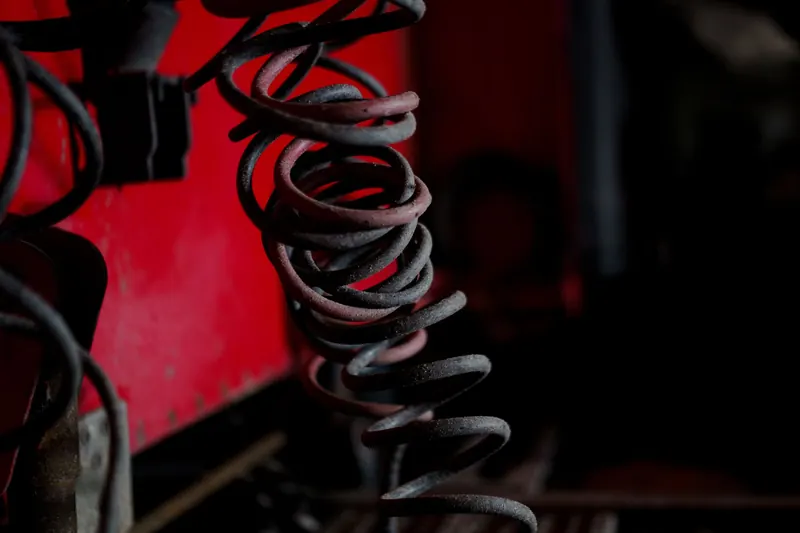
Broken garage door spring? How to spot it and what to leave alone
A snapped spring turns a garage door into a dead weight. Here is how to recognise it in a minute, why coastal garages see it often, and how to keep everyone safe until it's fixed.
 Right now
Power out in a storm? Using the garage door manual release safely
When a nor'easter takes the power, the red cord on the opener is how the car gets out. Pulled at the wrong moment it can drop a heavy door. Here is the safe way.